CHILD PROTECTION · BIOMONITORING · HUMAN OVERSIGHT
C.H.I.L.D.Child protection
infrastructure.
Comprehensive Harm Interdiction & Lifelong Defense:
Biomonitoring for Innocence Protection
A research proposal for connecting local sensing with human safeguarding—so potential signs of harm can receive earlier, proportionate attention.
Research status C.H.I.L.D. is a proposed framework. Its detection performance and safeguarding outcomes require independent evaluation.
01 / OVERVIEW
Local signals.
Accountable human response.
C.H.I.L.D. proposes a distributed child-protection infrastructure combining wearable biosensors, local anomaly detection, minimized event signals and AI–human guardian teams. The framework describes how changes in an individual child’s physiological patterns, movement, proximity and expected presence could inform contextual risk review. It organizes responses through graduated risk states, bounded retention, consent-aware routing and qualified human oversight. Its intended contribution is a technical and governance framework for child abuse prevention, safeguarding intervention and privacy-preserving monitoring. Detection performance, false-positive control and safeguarding outcomes require independent evaluation.
The paper brings sensing, event routing and governance into one specification. Local processing, bounded memory and human oversight are central to its proposed approach.
A physiological anomaly is a reason to examine context, not proof that abuse has occurred.
02 / ARCHITECTURE
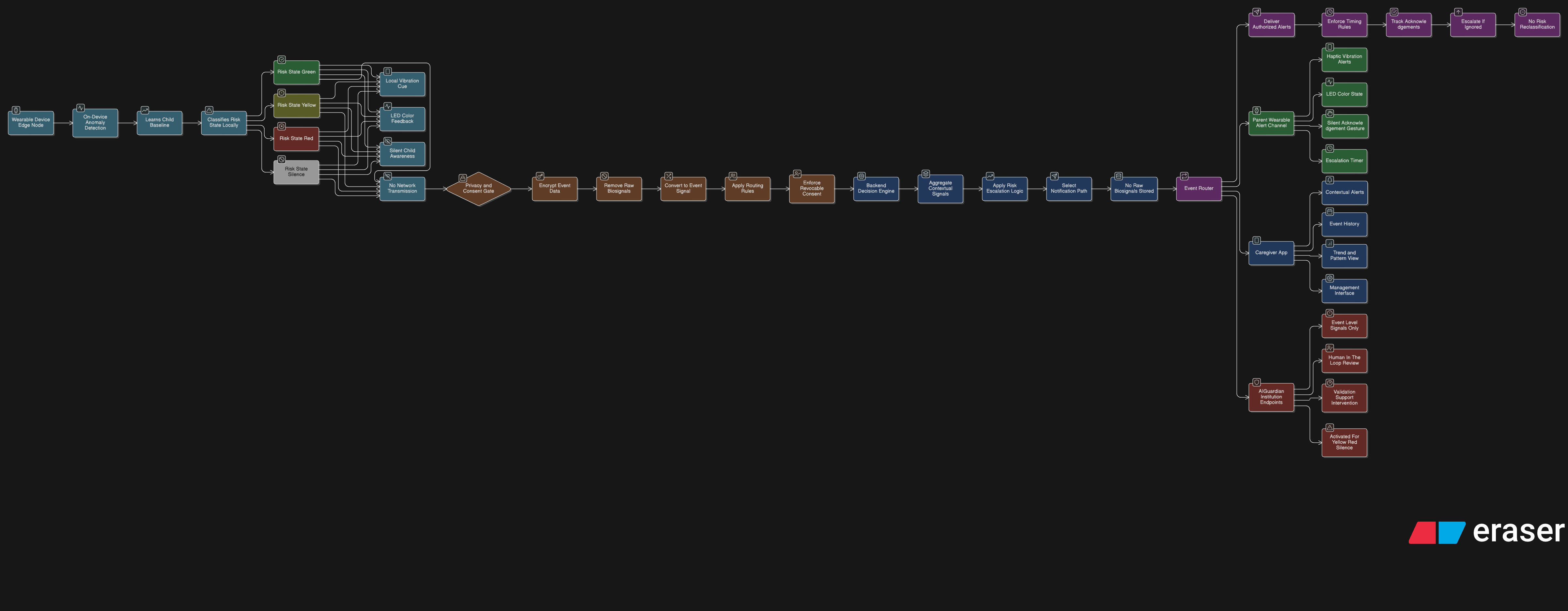
From sensing to safeguarding review
- 01
Local sensing
Wearable biosensors, movement and contextual inputs inform individual baselines and anomaly detection.
- 02
Event minimization
The proposed privacy and consent layer constrains which event signals are retained and routed.
- 03
Contextual review
AI-assisted Guardian services support qualified human interpretation of the event and its history.
- 04
Bounded escalation
Risk states, acknowledgment and retention rules organize proportionate follow-up.
03 / INDEPENDENT EVALUATION
Questions that deserve careful testing
The proposal invites examination across child welfare, wearable engineering, biosignal processing, clinical research and privacy. Independent evaluation can test whether its mechanisms support safe and useful safeguarding decisions.
- Detection validity — false positives, missed events and performance across different contexts.
- Human response — review quality, escalation thresholds and supported decision-making.
- Privacy and governance — consent, coercion, access controls, retention and independent oversight.
- Practical outcomes — acceptability, accessibility and effects on children and families.
The specification is research material, not a validated diagnostic tool or an operational emergency service.
04 / THE FULL PAPER
Read the specification.
Examine the details.
The complete version 2 manuscript and original architecture are available without signing in.
Open the 32-page PDF05 / CITATION
Keep the source
with the idea.
Use the research citation when discussing or evaluating this framework.
Sprenger, D. (2025). C.H.I.L.D. — Comprehensive Harm Interdiction & Lifelong Defense: Biomonitoring for Innocence Protection (Version 2) [Research framework]. https://doi.org/10.17605/OSF.IO/9M253
The citation year follows the v2 manuscript’s 14 December 2025 repository record. The PDF was added in April 2026; the DOI links to the OSF project.